Honestly, what does “body-safe” actually mean?
You’re looking at two products. Both say “body-safe.”
The first tells you what it’s made from, how to clean it, whether it can get wet, and anything important you should know before using it.
The second says:
Premium body-safe material.
That’s it.
Which one would I trust more?
The first one. Every time. Because “body-safe” sounds reassuring, but on its own, it doesn’t tell you very much.
The better question is: What is this product actually made from and has the brand given me enough information to understand it?
The short answer
Don’t stop at the “body-safe” badge. Read the details underneath it.
First: what is it actually made from?
Start here.
If a product page says:
Material: Body-safe
you still don’t know the material. Think of it like buying a sweater whose label says "Material: Comfortable"
Comfortable sounds nice. But is it cotton? Wool? Polyester?
Same problem.
What you actually want to see is a material name.
More useful:
Material: Silicone
Not very useful:
Material: Premium body-safe material
Why does knowing the material matter?
Because it gives you somewhere useful to start. It helps you understand:
- how the product should be cared for
- whether other materials or coatings are involved
- what the manufacturer says is compatible with it
- what to look for if the surface becomes damaged
You do not need to become a materials expert.
You just need the brand to tell you what you’re buying.
Plum recommends — If the actual material isn’t clearly listed, keep looking.
Okay, so which materials will I actually see?
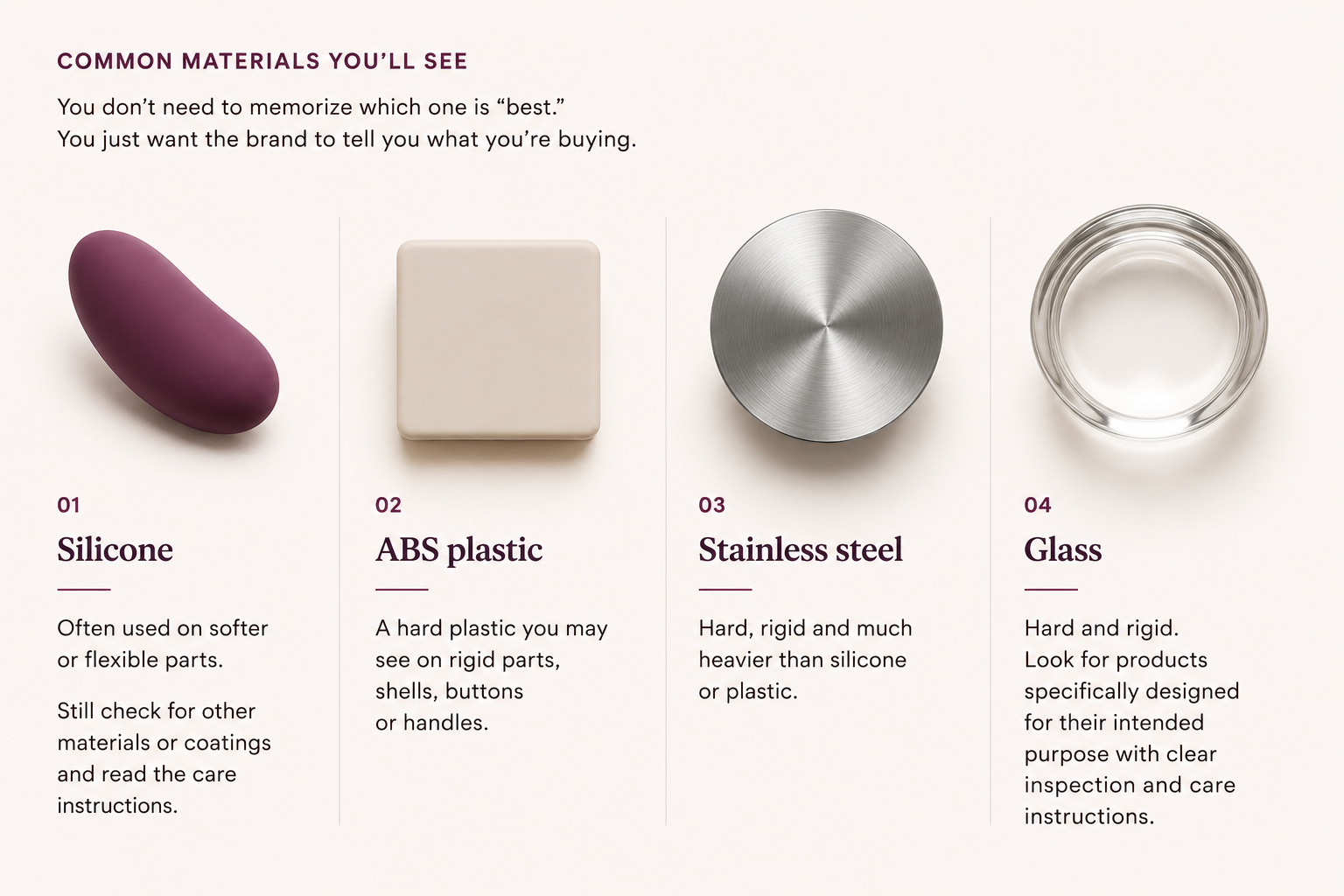
You’ll commonly come across names like:
- Silicone
- ABS plastic
- Stainless steel
- Glass
You do not need to memorize which one is supposedly “best.”
That isn’t really the point.
The more useful question is:
Does the brand clearly tell me what the product is made from and how I’m supposed to look after it?
Silicone
Silicone is common on softer and more flexible products.
Seeing silicone on the material line is useful.
But keep reading.
You still want to know:
- Is the whole surface silicone?
- Are other materials used?
- Is there a coating or finish?
- How should it be cleaned?
- Are there compatibility instructions?
The word silicone is useful information.
It just isn’t the whole product description.
ABS plastic
ABS is a hard plastic you may see on rigid parts such as shells, buttons, handles, or other structural areas.
You do not need to understand the chemistry.
You mainly want the brand to be clear about where it is used and how that part of the product should be cared for.
Stainless steel
Stainless steel is hard, rigid, and much heavier than silicone or plastic.
If you’re considering a product made with stainless steel, look for clear material information and straightforward care guidance for the finished product.
Glass
Glass is also hard and rigid.
If you’re considering one, look for a product specifically made for its intended use and follow the manufacturer’s inspection and care instructions.
The thing to remember
You do not need to stand in a store thinking:
Wait, which material was I supposed to buy again?
Instead ask:
Has this brand clearly told me what I’m buying?
That question will get you surprisingly far.
Material is only half the story
This is the part people often miss.
Imagine two products.
Both say:
Material: Silicone
The first has:
- a smooth, intact surface
- clear cleaning instructions
- clear water guidance
- clear storage instructions
The second has:
- an unexplained coating
- awkward seams
- almost no care information
- vague instructions about water
Would you treat those as the same purchase? I wouldn’t.
The material matters.
But the finished product matters too.
Look at the surface
Does it look smooth and intact?
If something you already own starts peeling, cracking, or changing in a way you weren’t expecting, don’t just ignore it. Check the manufacturer’s guidance.
Look for coatings or finishes
Sometimes brands use words like:
- silky
- soft-touch
- velvet finish
- premium coating
Those describe how something feels.
They don’t necessarily tell you what is actually on the surface.
If a coating matters to the product, the brand should explain what it is and how to care for it.
Look at seams and joins
Check where different parts meet.
You don’t need to inspect it like an engineer.
You’re simply asking:
Does this look straightforward to clean and maintain?
Read the instructions
This might be the most useful clue of all.
A good product page should explain how to care for the finished product, not leave you searching online for guesses.
Plum recommends — Read the material information and care instructions together. They tell you much more than either one alone.
What does “phthalate-free” mean?
You’ll see this one a lot.
Let’s keep it simple.
Phthalates are a group of chemicals. Some have been used to make certain plastics softer or more flexible.
So when a manufacturer says:
PHTHALATE-FREE
they are making a claim about phthalates.
That can be useful information.
But here’s what it doesn’t tell you:
What is the product actually made from?
A product could say:
Phthalate-free
BPA-free
Non-toxic
Body-safe
…and you could still be sitting there asking:
Okay. But what is it?
That’s the problem.
Think of “free-from” claims as extra information, not a replacement for the material line.
Plum recommends — A “free-from” claim should add to the product information, not replace it.
What about “BPA-free”, “non-toxic”, and “hypoallergenic”?
Same idea.
These claims may tell you something specific the brand wants you to know.
But none of them answers the most basic question:
What is the product made from?
So don’t automatically treat these words as meaningless.
Just don’t let them distract you from the basics.
A useful product page should still explain:
- the material
- relevant coatings or finishes
- care instructions
- compatibility information
- important limitations
If those basics are missing, a long row of reassuring badges doesn’t really solve the problem.
The care instructions tell you a lot
Before buying something, scroll down to the care section.
Seriously.
You should be able to answer a few basic questions.
How do I clean it?
The brand should tell you.
You shouldn’t have to invent your own method.
Can it be rinsed?
Check the instructions for that specific product.
Don’t assume every product can be treated the same way.
Can it get wet?
Look for clear water-resistance guidance.
“Water-resistant” and “waterproof” aren’t enough on their own.
You want to know what the manufacturer actually says the product can handle.
Does anything need to stay dry?
Charging areas, openings, or different components may have their own instructions.
How should I store it?
If the product has specific storage instructions, they should be easy to find.
Are there compatibility instructions?
If certain cleaners, lubricants, or other products need special consideration, the manufacturer should explain that too.
If you can’t find those answers before buying, you shouldn’t have to guess afterward.
Plum recommends — Clear care instructions are part of good product information. Treat them that way.
The 30-second “body-safe” check
Next time you see BODY-SAFE, ignore the badge for 30 seconds.
Check these four things instead.
1. Material
Does it actually say what the product is made from?
If not, you’re already missing basic information.
2. Construction
Does anything about the surface, coating, seams, or design need explaining?
You should understand what you’re buying.
3. Care
Can you easily find out how to clean and store it?
You shouldn’t have to guess.
4. Limitations
Does the brand explain water exposure, compatibility, and anything important you shouldn’t do?
Four clear answers?
Great. Now you actually know something useful about the product.
Just a “body-safe” badge surrounded by marketing copy?
Keep looking.
The Plum takeaway
Don’t stop at “body-safe.”
You don’t need to understand chemistry.
You don’t need to memorize a list of supposedly perfect materials.
And you definitely don’t need to become an expert before buying anything.
You need the brand to answer four basic questions:
What is it made from?
How is it constructed?
How do I care for it?
What are its limitations?
“Body-safe” shouldn’t be the complete answer.
It should be the beginning of the explanation.
Editorial disclosure
Plum Learn is published by Plum, an intimate wellness product company. This article may reference products sold by Plum.
We aim to distinguish general education from product-specific claims and to describe materials, care requirements, and limitations clearly.
This article provides general information and is not individualized medical advice.
Sources
This guide was informed by product-safety guidance and public information from organizations including ISO, Health Canada, and the U.S. Consumer Product Safety Commission.